Category: Sermon Post

  • KINGLESS: Judges 21

    KINGLESS: Judges 21

    OUTLINE
    “In those days there was no king in Israel. Everyone did what was right in his own eyes.” (Judges 21:25).
    But…
    I. There is a King coming who will do what is right in the LORD’s eyes
    II. There is a King coming who will defeat the giant enemies of the LORD’s people
    III. There is a King coming who will establish a kingdom that will never end

    DISCUSSION
    1. Read chapter 21 and write down what stands out to you as the people of Israel scramble to reverse what they have done to wipe out the tribe of Benjamin.

    2. How does verse 25 perfectly sum up the book of Judges? What are some scenes wherein you vividly remember someone doing “what was right in his own eyes”?

    3. Look back through the entire study at all of your answers. What was new? What was convicting? What was encouraging?


  • HOPELESS: Judges 20

    HOPELESS: Judges 20

    OUTLINE
    I. Hopeless are all who stand trial for their sin without an advocate
    II. Hopeless are all who will not part with sin
    III. Hopeless are all who rage against the justice of the LORD
    IV. Hopeless are all who try to do the LORD’s work in their own strength
    V. Hopeful are all who take refuge in the Rock

    DISCUSSION
    1. Chapter 20 reveals further moral corruption in Israel, this time by the entire nation subjecting one of their tribes to complete annihilation. Read verses 1-11. What does the writer mean by “from Dan to Beersheba”? How did the people of Israel initially respond to “this evil” that had happened? What does the Levite leave out when he tells them of the evil that was done to his concubine by the leaders of Gibeah? How did the people of Israel eventually respond to “this evil”?

    2. Read verses 12-17. What did the people of Israel demand from the Benjaminites? How do Deuteronomy 13:5 and 17:7 shed light on their demands? How did the Benjaminites respond?

    3. Read verses 18-28. What admirable thing do the people of Israel do time and time again in these verses? What can we learn from these verses? What else stands out to you in these verses and why?

    4. Read verses 29-48. According to verse 35, who defeated Benjamin? What can we learn from this? How far did the people of Israel take this civil war according to verse 48? What else stands out to you in these verses and why?

  • WORTHLESS: Judges 19

    WORTHLESS: Judges 19

    OUTLINE
    I. If we base our sexual ethic according to what is right in our own eyes, we are worthless (v.1-2,22-25)
    II. If we choose what we do each day based on what is right in our own eyes, we are worthless (v.4-5,9)
    III. If husbands refuse to lead, love, provide for, and protect their wives and instead do what is right in their own eyes, they are worthless (v.25-28)
    IV. If we are outraged at the evil done by others yet unmoved by our own, we are worthless (v.29-30)

    1. Chapter 19 begins to show the moral corruption of the people of Israel. First, this is shown by a Levite and the treatment of his concubine. Second it is shown by how the “worthless fellows” treat these sojourners. Read verses 1-9. What is the current setting in Israel that we are reminded of in verse 1? What is a concubine—how does the ESV Study Bible note on verse 1 shed light on the answer? How does the concubine’s father treat the Levite when he comes to his house? How does the Levite respond? What else stands out to you in these verses and why?
    2. Read verses 10-21. Why did the Levite not want to “spend the night in the city of the Jebusites” but rather “pass on to Gibeah”? Who offered hospitality to the Levite and his concubine? What else stands out to you in these verses and why?
    3. Read verses 22-28. What do the “worthless fellows” do? How is this reminiscent of Genesis 19, when the angels come to Lot’s house in Sodom? What did the master of the house do when the worthless fellows demanded the Levite? What did the Levite do? How does this make us long for Jesus? What should they have done? What did the worthless fellows end up doing to the concubine? What else stands out to you in this passage and why?
    4. Read verses 28-30. How did the Levite initially respond when he realized his concubine was dead? How should he have initially responded? How did he eventually respond? How should this make us long for Jesus? What else stands out to you in this passage and why?
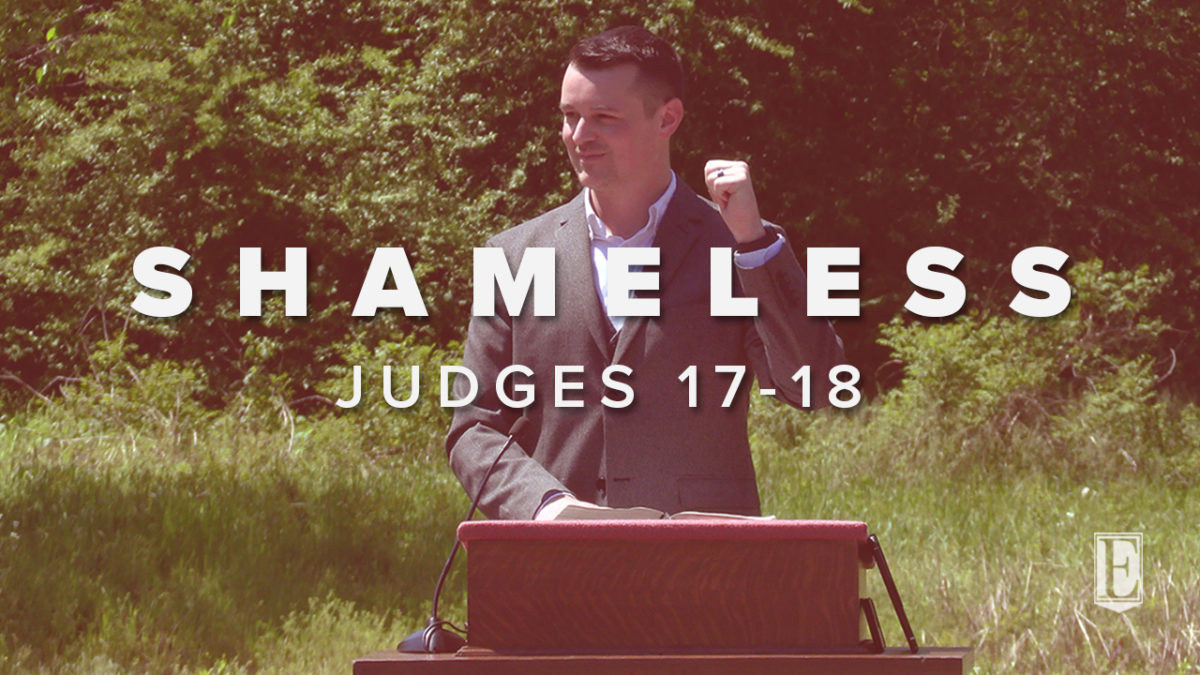
  • SHAMELESS: Judges 17-18

    SHAMELESS: Judges 17-18

    OUTLINE
    I. You cannot serve the LORD and idols (v.1-6)
    II. You cannot trust Jesus and yourself (v.7-13)
    III. You cannot love the LORD and money (17:10-11, 18:4-6, 18-20, Matthew 6:24)
    IV. If you serve idols or trust yourself or love money, the temporary results will be either 1) empty hands or 2) enslavement. The eternal results will be destruction (ch.18, Philippians 3:18-19)

    1. Chapter 17 begins showing the depths of Israel’s apostasy. The first section, Judges 17:1–18:31, is an example of their religious corruption. Read verses 1-5. What did Micah confess to his mother? How did his mother respond? What did she do with the silver and who did she dedicate it to? What did Micah do with the carved image? How is this reminiscent of Exodus 32:1-10? How does Exodus 20:4 reveal the foolishness of Micah and his mother? What else stands out to you in these verses and why?
    2. Read verses 6-13. How should verse 6 make us long for Jesus? Further evidence is shown here of Israel’s religious corruption. This time it is not a family in general, but a Levite in particular. Why did the Levite become “content to dwell with the man”? Were priests meant to be private servants of families of public servants of the people? What did Micah think would happen now that he had a Levite as his very own priest, according to verse 13?
    3. After showing the religious corruption of a family (Micah and his mother) and of a Levite, the narrative now turns to showing the religious corruption of an entire tribe, the Danites. Read verses 1-6. Why were the five Danites spying out and exploring the land? Where was the Danites allotted territory according to Joshua 19:40-47? How does Judges 1:34-35 help us understand why they did not possess an inheritance? Where did they end up finding lodging? What did they ask the Levite to do? Does anything in the text say that the Levite actually inquired of the LORD? How does Jeremiah 10:21 shed light on the stupidity of this kind of promise? What does Jeremiah 10:21 say the results of such stupidity would be?
    4. Read verses 7-21. What did the Danites find when they scouted the land of Laish and how did they respond? How should they have responded? What did they end up doing to Micah and the Levite? How did the Levite respond? What else stands out to you in these verses and why?
  • PRAY FOR ALL PEOPLE: 1 Timothy 2:1-7

    PRAY FOR ALL PEOPLE: 1 Timothy 2:1-7

    OUTLINE
    I. We must pray
    II. Who we must pray for
    III. Why we must pray

    1 TIMOTHY 2:1-7
    First of all, then, I urge that supplications, prayers, intercessions, and thanksgivings be made for all people, for kings and all who are in high positions, that we may lead a peaceful and quiet life, godly and dignified in every way. This is good, and it is pleasing in the sight of God our Savior, who desires all people to be saved and to come to the knowledge of the truth. For there is one God, and there is one mediator between God and men, the man[a] Christ Jesus, who gave himself as a ransom for all, which is the testimony given at the proper time. For this I was appointed a preacher and an apostle (I am telling the truth, I am not lying), a teacher of the Gentiles in faith and truth.

    The Holy Bible, English Standard Version. ESV® Text Edition: 2016. Copyright © 2001 by Crossway Bibles, a publishing ministry of Good News Publishers.

  • SAMSON (pt.5): Judges 16:23-31

    SAMSON (pt.5): Judges 16:23-31

    OUTLINE
    I. Our unfaithfulness brings reproach upon the name of the LORD (v.23-27)
    II. For the sake of His name, the LORD overrules our unfaithfulness and causes us to glorify Him again (v.28-31)
    III. Samson is never more reminiscent of Jesus than in his death

    1. Read verses 23-24. Why do the Philistines gather? Who did they sacrifice to? Why did they worship Dagon here? How does the LORD humiliate the idol Dagon and his worshipers in 1 Samuel 5:1-5?
    2. Read verses 25-27. Why did the Philistines bring Samson out in the midst of their rejoicing? How many Philistines, and of what kind, were present? What does Samson do when he is brought out and how does this further show his cunning?
    3. Read verse 28. What did Samson ask of the LORD? Why did he ask this? Do you think this was the right motivation—how does Deuteronomy 32:35-36 shed light on the answer? What would have been the right motivation?
    4. Read verses 29-31. What did Samson do after he was placed by the pillars? In what way is Samson like Jesus? In what ways is he different? What can we learn from the life and death of Samson?
  • NO CORRUPTION; PLEASURES FOREVERMORE: Psalm 16

    NO CORRUPTION; PLEASURES FOREVERMORE: Psalm 16

    All who take refuge in Jesus…
    I. Will be preserved by the LORD (v.1)
    II. Have all the good they need—they have found the One whom their soul loves (v.2,5-6)
    III. Delight in His saints and detest the way of idolators (v.3-4)
    IV. Praise the LORD as they listen to His counsel (v.7-8)
    V. Are glad and rejoice (v.9)
    VI. Will never be abandoned nor see corruption (v.10)
    VII. Will be joyfully satisfied in His presence forever (v.11)

  • SAMSON (pt.4): Judges 16:1-22

    SAMSON (pt.4): Judges 16:1-22

    1. Read verses 1-3. What did Samson do when he went to Gaza? What has characterized Samson thus far in the book of Judges? What else stands out to you in these verses and why?
    2. Read verses 4-9. How is this scene reminiscent of Judges 14:15-18? In what ways are they alike? In what ways are they different? What does Samson tell Delilah when she asks for his secret?
    3. Read verses 10-17. What seems to be Samson’s Achilles heel? What else stands out to you in this passage and why?
    4. Read verses 18-22. What does the writer say happened when Samson had his hair cut off? Does there seem to be some kind of irony here? What did the Philistines do to Samson after his strength left? What does verse 22 imply? What else stands out to you in these verses and why?
  • SAMSON (pt.3): Judges 15

    SAMSON (pt.3): Judges 15

    1. Read verses 1-8. What does Samson do when he learns that his wife has been given to his companion? What does he do to the Philistines who “burned [his wife] and her father with fire”? How does the narrative move forward, with forgiveness and reconciliation or retaliation and retaliation? How should this make us long for Jesus?
    2. Read verses 9-13. What did the Philistines do when they learned of Samson—that the LORD had raised him up as a judge for Israel? What did “the men of Judah” do when the Philistines told them their plans for Samson? What should they have done for the judge the LORD had raised up to save them? What can we learn from these verses?
    3. Read verses 14-17. What did Samson do to the thousand men that came to kill him? Where did Samson’s strength clearly come from? What else stands out to you in these verses and why?
    4. Read verses 18-20. This is the first prayer of Samson that is recorded. What can we learn about Samson as we examine his prayer? What can we learn about the LORD as we examine how he answered? What else stands out to you in these verses and why?
  • SAMSON (pt.2): Judges 14

    SAMSON (pt.2): Judges 14

    1. Read verses 1-9. What do we learn in these verses concerning the cleverness of Samson? Where did Samson’s strength come from and how is it apparent in these verses? What else stands out to you in these verses and why?
    2. Read verses 10-18. What light does the ESV Study Bible note on verse 10 shed on the word “feast”? Why is this significant to understand? How do these verses show us the weakness of Samson when it comes to women? What else stands out to you in these verses and why?
    3. Read verses 19-20. What is the result of Samson disclosing the riddle’s answer to his wife, and she then betraying him to the 30 men? What do we learn about Samson here? How should these verses make us long for Jesus?